
California has some of the strongest worker protections in the country, but violations happen every day, and they often look like “normal” workplace friction rather than something illegal. A demanding boss, a missed break here and there, a confusing pay stub: on their own, these can seem like nothing. Together, or over time, they can be signs that your employer is breaking the law. Here are five to watch for.
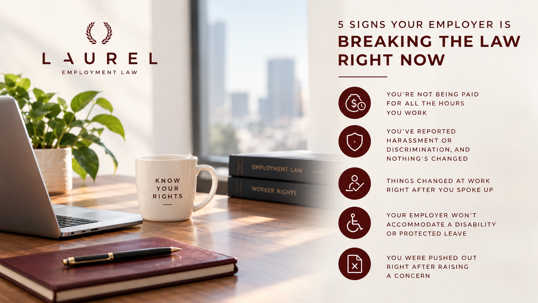
1. You're Not Being Paid for All the Hours You Work
If you're regularly working through lunch, clocking in before your shift officially starts, answering work messages off the clock, or not getting paid time and a half after eight hours in a day, that's not just unfair, it's a wage and hour violation under California law. The same goes for missed meal and rest breaks: California requires a 30-minute meal break for shifts over five hours and paid 10-minute rest breaks for every four hours worked, and an employer who makes that difficult or discourages you from taking them owes you an extra hour of pay for every day it happens. See our pages on overtime violations and meal and rest break violations for more.
2. You've Reported Harassment or Discrimination, and Nothing's Changed
Unwelcome conduct based on a protected characteristic, whether that's sex, race, age, disability, or something else, doesn't stop being illegal just because HR shrugged it off. California's Fair Employment and Housing Act (FEHA) protects employees from workplace harassment and discrimination at employers of any size, and that protection doesn't disappear just because a complaint went nowhere. If you're not sure whether what you're experiencing crosses a legal line, our post on the top signs you might be a victim of workplace sexual harassment walks through the warning signs, and our guide on how to document sexual harassment at work in California covers what to do next. The California Civil Rights Department is the state agency that investigates these complaints.
3. Things Changed at Work Right After You Spoke Up
A sudden negative performance review, a demotion, reduced hours, or exclusion from meetings shortly after you reported harassment, filed a wage claim, or raised a safety concern is a classic pattern of workplace retaliation, which is illegal under California law separately from whatever you originally reported. We've written about the top signs you might be a victim of workplace retaliation and how to prove retaliation after reporting harassment, and if the “evidence” against you is a performance review that seems to have appeared out of nowhere, our post on whether performance reviews can be discriminatory is worth a read. You can also file a retaliation complaint directly with the California Labor Commissioner's Office.
4. Your Employer Won't Accommodate a Disability or Protected Leave
Employers covered by the ADA and FEHA are generally required to provide reasonable accommodations for disabilities and to engage in good faith with employees who request them, not simply deny the request or ignore it. The same goes for job-protected leave under the Family Medical Leave Act (FMLA) and California's parallel leave laws. If your request for an accommodation was denied, delayed indefinitely, or met with pressure to just quit instead, see our page on ADA compliance and failure to accommodate, as well as our recent post on what to do if your employer denies a disability accommodation. Understanding your rights before you talk to anyone at work makes a real difference in how that conversation goes.
5. You Were Pushed Out Right After Raising a Concern
Being fired, laid off, or pressured to resign shortly after reporting misconduct, filing a complaint, or refusing to do something illegal is one of the clearest red flags of all. California Labor Code Section 1102.5 specifically protects employees who report suspected violations of law, and a termination that looks like payback for that can amount to both whistleblower retaliation and wrongful termination. And if you're handed a severance agreement on your way out the door, don't sign anything before reading our guide on what California employees should know before signing a severance agreement.
Don't Wait to Find Out Where You Stand
If even one of these signs sounds like what's happening at your job, don't talk yourself out of it. The law doesn't require you to have everything figured out before you ask for help, and waiting only makes it harder to prove what happened and easier for an employer to cover its tracks. Laurel Employment Law, APC represents workers exclusively, and we can tell you quickly whether your employer has crossed a legal line.
Your consultation is free, and there's no fee unless we win.
Schedule Your Free Consultation or call us now at (855) 477-1016.
We work on a contingency fee basis, so you pay nothing to find out where you stand.