

No. Holiday pay in California is not required by state law for private employers: California does not require paid holidays, and it does not require a holiday premium such as time and a half or double time just because the day is Thanksgiving, Black Friday or Christmas. But that is not the end of the story. If your holiday shift is long enough, California's daily overtime and double time rules still apply, and your employer may owe you holiday pay if its own policy, contract or union agreement promises it.
When holiday pay is required in California
The state does not set a holiday pay rule for most private employers, so the answer usually comes from your own paperwork. You may be owed holiday pay if:
- Your employee handbook or written pay policy promises paid holidays or a holiday premium rate.
- Your offer letter or employment contract includes holiday pay.
- You are covered by a union or collective bargaining agreement that sets holiday pay.
- Your employer has a consistent practice of paying it and told employees to expect it.
When a policy or contract promises holiday pay and the employer does not pay it, the missing amount can be treated as unpaid wages. That is why it is worth finding the written policy before assuming you are out of luck.
Is holiday pay double time in California?
Not automatically. Double time is triggered by hours worked, not by the calendar. Under California law, non-exempt employees are generally owed:
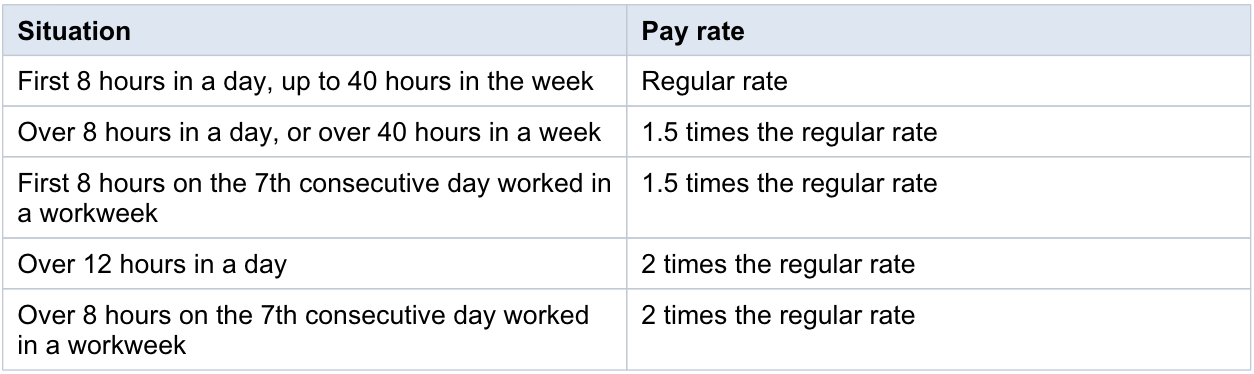
So a holiday shift can absolutely end up paying double time, but only because of how many hours you worked. A 6-hour shift on Thanksgiving, with no other overtime triggers that week, can legally be paid at your regular rate if your employer has no holiday pay policy.
Is Black Friday time and a half in California?
There is no rule that makes Black Friday time and a half. Retail and warehouse employees often work long days in the week of Thanksgiving, and that is where overtime shows up. If you work more than 8 hours on Black Friday, the hours past 8 are paid at 1.5 times your regular rate. If you work more than 12, the hours past 12 are paid at double time. Working more than 40 hours in the week also triggers overtime.
Here is a simple example. Say you earn $20 an hour and work 10 hours on Black Friday:
- 8 hours at $20 equals $160
- 2 hours at $30 (overtime) equals $60
- Total for the day: $220
If your employer advertised a "holiday rate" for that day, it must pay the advertised rate and still calculate overtime correctly on top of it.
Common holiday pay problems
Skipped overtime on long holiday shifts. Retail, warehouse, restaurant and delivery employees often work extended hours around the holidays. Check your pay stub to confirm hours past 8 in a day were paid at the overtime rate.
Holiday bonuses left out of the regular rate. A bonus that is promised or tied to hours, attendance or production generally has to be included when your overtime rate is calculated. Leaving it out can shortchange your overtime.
Salaried does not always mean exempt. Salaried employees are only exempt from overtime if they meet a minimum salary threshold and perform qualifying job duties. A job title or a salary alone does not remove overtime rights.
Missed breaks on busy days. Meal and rest break rules do not pause for holidays. If you were not given required breaks on a rush day, you may be owed premium pay. Read more about meal and rest break violations on our Meal and Rest Break Violations page.
Sent home early. In many industries, an employee who reports for a scheduled shift and is sent home early may be owed reporting time pay for part of the shift.
Can my employer make me work on Thanksgiving?
Generally yes. California does not guarantee time off on holidays in the private sector. There are limits, though. An employer may not discriminate in scheduling, must reasonably accommodate sincerely held religious beliefs when it can do so without undue hardship, and cannot retaliate against you for asking about your pay rights. If you have a contract or union agreement that guarantees holiday time off, that agreement controls.
What to do if you were not paid correctly
- Save your records. Keep pay stubs, schedules, texts about shift changes, time clock screenshots and a copy of any handbook policy on holiday pay.
- Compare hours to pay. Check each day's hours against the rates in the table above.
- Raise it in writing. A short, polite email to HR or payroll asking for a correction creates a record and often resolves simple errors.
- Know the deadline. Unpaid wage claims generally have a three year window, and sometimes four, but acting quickly makes records easier to find.
- Talk to an employment lawyer. An attorney can review your pay stubs and tell you whether overtime or holiday pay is owed.
Holiday season is also a time when family and caregiving needs come up. If you need time off for a family member, our post on what FMLA means for holiday time caregiving explains your options.
Frequently asked questions
Does California require paid holidays?
- No. Private employers are not required to provide paid holidays. If your employer offers them, the policy or contract sets the rules.
Do I get holiday pay if I do not work the holiday?
- Only if your employer's policy, contract or union agreement provides paid holidays. Hours you are paid for but do not work generally do not count toward the 40 hour weekly overtime threshold.
Is working on a holiday automatically overtime?
- No. Overtime depends on hours worked in the day and week, and whether it is your seventh consecutive day. A holiday on its own does not trigger overtime
What if my employer promised a holiday rate and did not pay it?
- A promised rate that goes unpaid can be a wage claim. Gather the written policy or message that made the promise and your pay stubs, then speak with an attorney.
Questions about your holiday pay?
If your holiday hours were not paid correctly, Laurel Employment Law can review your situation. Learn more about your rights on our Overtime Violations page and Wage and Hour Law page, or contact our team.